
The Advanced Stainless Steel Fabrication Shop Handles a Wide Range of Tasks
The stainless steel fabrication shop at Engskov Maskinfabrik is to a large extent set up for continuous deliveries of tanks for Vestergaard’s so-called Elephant de-icing machines.
However, the shop’s employees and equipment can handle many other tasks as well.

A Team That Complements Each Other
When a new de-icing machine for the aviation industry – Elephant BETA or Elephant MY – rolls out of Vestergaard’s factory in Gevninge, there is a strong likelihood that it contains a tank built in the stainless steel department at Engskov Maskinfabrik.
Here, Morten Korsgaard Hansen works as a stainless steel sheet metal worker and coordinator for the tasks carried out by himself and four colleagues. Morten recently turned 60 and has previously had a working life involving a great deal of travel. He worked with installation and service on slaughterhouse facilities all over the world.
When he decided a few years ago to leave behind a travelling working life, there was demand for him at Engskov. And Morten is very satisfied with that today:
“Engskov Maskinfabrik is a really good place to work. There is not far to the top and to the decision-making, we have good working conditions, and there is a strong sense of unity and cooperation,” he says.
A Team That Complements Each Other
Like Morten himself, the four colleagues in the stainless steel department bring many different kinds of experience to their current jobs at Engskov.
Christian and Michael originally worked as blacksmiths in carbon steel, but have learned to work in stainless steel. Like Morten, Mark is a sheet metal worker specializing in stainless steel, while Jonas comes from a completely different background – earthworks and concrete – before starting at Engskov:
“We work in such a way that everyone in the department learns to master every stage of production. That way, we avoid becoming too vulnerable to holidays, illness or peak loads elsewhere in the factory that may take one of us out of operation. Then the others can take over,” says Morten.
A Well-Equipped Fabrication Shop – and Boilers for Vestergaard
The production hall that makes up Engskov’s stainless steel department is well equipped with cranes, cutting tools, special turning stations and TIG welding equipment. Everything is arranged with maximum consideration for ergonomics and the working environment.
“We have personally helped design our department and set up the different machines so that proper account is taken of working height and material handling. That is something we care a great deal about here. Employees should not be worn out by their work,” says Morten.
Boilers for Vestergaard
The stainless steel department does all sorts of work. But every week, special boilers are produced – a type of tank with heat exchangers that form part of Vestergaard’s de-icing machines.
“When the de-icing machines are in use, it is the boilers produced here, among other things, that heat the glycol before it is distributed onto the aircraft wings,” Morten explains.
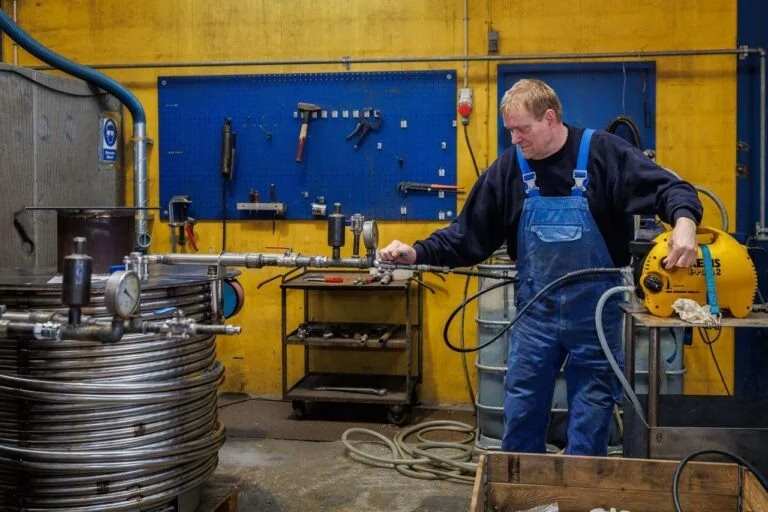
The boilers are fitted with stainless steel coils, and these – an inner coil and an outer coil – are turned and welded together in the department:
“Depending on the size of the boiler we are building, lengths of 12 or 6 metres of stainless steel tubing are coiled and welded together. These are tubes made of a heat-resistant steel grade, so we have to use a special welding technique to assemble the heating coils for the boilers,” Morten explains.
The finished heating coils must be leak-tight and able to withstand an operating pressure of 7 bar, but before Vestergaard’s own quality control tests the finished coils, Engskov has already had them tested for a day and a half at 22 bar pressure.
“We take pride in ensuring that the finished coils pass external inspection without any issues,” says Morten.
A Well-Equipped Fabrication Shop – and Boilers for Vestergaard
The production hall that makes up Engskov’s stainless steel department is well equipped with cranes, cutting tools, special turning stations and TIG welding equipment. Everything is arranged with maximum consideration for ergonomics and the working environment.
“We have personally helped design our department and set up the different machines so that proper account is taken of working height and material handling. That is something we care a great deal about here. Employees should not be worn out by their work,” says Morten.
Boilers for Vestergaard
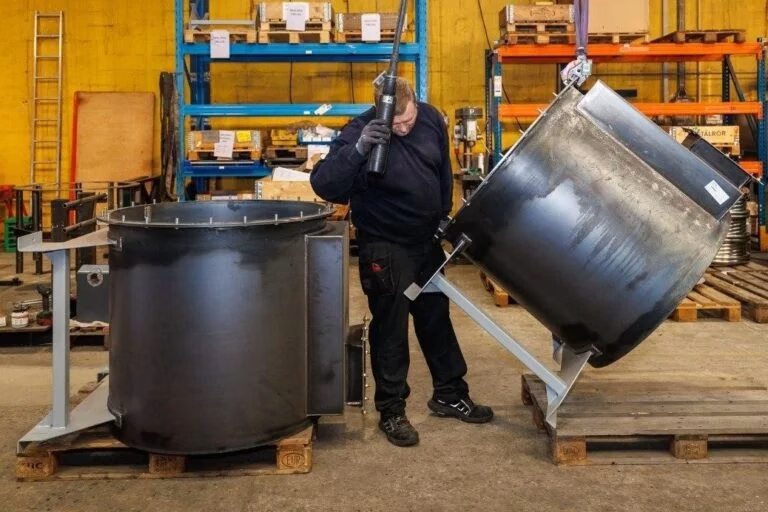
The stainless steel department does all sorts of work. But every week, special boilers are produced – a type of tank with heat exchangers that form part of Vestergaard’s de-icing machines.
“When the de-icing machines are in use, it is the boilers produced here, among other things, that heat the glycol before it is distributed onto the aircraft wings,” Morten explains.
The boilers are fitted with stainless steel coils, and these – an inner coil and an outer coil – are turned and welded together in the department:
“Depending on the size of the boiler we are building, lengths of 12 or 6 metres of stainless steel tubing are coiled and welded together. These are tubes made of a heat-resistant steel grade, so we have to use a special welding technique to assemble the heating coils for the boilers,” Morten explains.
The finished heating coils must be leak-tight and able to withstand an operating pressure of 7 bar, but before Vestergaard’s own quality control tests the finished coils, Engskov has already had them tested for a day and a half at 22 bar pressure.
“We take pride in ensuring that the finished coils pass external inspection without any issues,” says Morten.